A Day in Kamakura
Jun. 29th, 2008 08:54 am![[personal profile]](https://www.dreamwidth.org/img/silk/identity/user.png) aide
aideI'm pissed that my camera died halfway through the day so I don't have many pictures after lunch. For all of my pictures, they're at Photobucket. As always, I'm going to reguritate random wiki info to suppliment my lack of knowledge or being able to read any of the Japanese signage.
Justin and I went to Kamakura yesterday and it was a blast. We did a shitton of walking and I even got a bit of a burn on my shoulders despite there being no sun. I told Justin as much at one point during the day because he was wanting to get his Philipino tan back. We were supposed to meet in Tokyo station at 9am so we could get there around 10 and start the day early but we ended up meeting around 10am because Justin couldn't wake up. We caught the Yokosuka-Sobu line from Tokyo station and an hour later we were in Kamakura. From the train you could see this giant white Kanno statue amongst the trees - the Ofuna Kannon. Maybe we'll do that when we go to Enoshima as well.

We fought our way out of the station and started to make our way through the city. My original plan was to do a few of the hiking trails in my book, which hit the Buddha first and then a few of the major temples and shrines before ending up at Kita-Kamakura station but that didn't happen. I side tracked us and took us to a few smaller shrines that I saw signs for and ended up doing the route of the course in reverse.

Our first major stop was 寿福寺 Jufuku-ji. This Rinzai sect temple is the oldest Zen temple in Kamakura, ranked third among Kamakura's Five Mountain temples. Here, they worship Shakymuni, the Buddha. This temple was founded by Hojo Masako (1157-1225) to enshrine her dead husband, the founder of the Kamakura shogunate, Minamoto Yoritomo (1147-1199). She installed Eisai as the founding priest, who was ordained in China and brought Zen buddhism to Japan. He is also credited with bringing green tea to Japan, which was orginally used to keep monks awake during long sessions of meditation. Look, I learned something in Asian Studies; I bet you didn't know that.

The main hall is closed to visitors, which is a shame. It was so peaceful and calm there... we could see monks walking around inside and a family coming out of the reception area. Apparently (as Wikipedia tells me) there are 3 statues of Shakyamuni, an eleven-headed goddess Kannon and two Deva Kings inside. Behind the hall is a graveyard as well, where all the head priests of the temple are buried. There are a few graves dedicated to some Minamotos, some foreigners and a few literary celebrities.
Next we made our way to 銭洗弁天 Zeniarai Benten, "Money-washing Benten". It was near by but you had to up this steep hill to get to the entrance. This is when we started to see some crowds, and a lot of foreigners. It was quite nice and cool up on the top of the hill though because there was a lot of shade from trees and nice cool caves.

Justin and I went to Kamakura yesterday and it was a blast. We did a shitton of walking and I even got a bit of a burn on my shoulders despite there being no sun. I told Justin as much at one point during the day because he was wanting to get his Philipino tan back. We were supposed to meet in Tokyo station at 9am so we could get there around 10 and start the day early but we ended up meeting around 10am because Justin couldn't wake up. We caught the Yokosuka-Sobu line from Tokyo station and an hour later we were in Kamakura. From the train you could see this giant white Kanno statue amongst the trees - the Ofuna Kannon. Maybe we'll do that when we go to Enoshima as well.
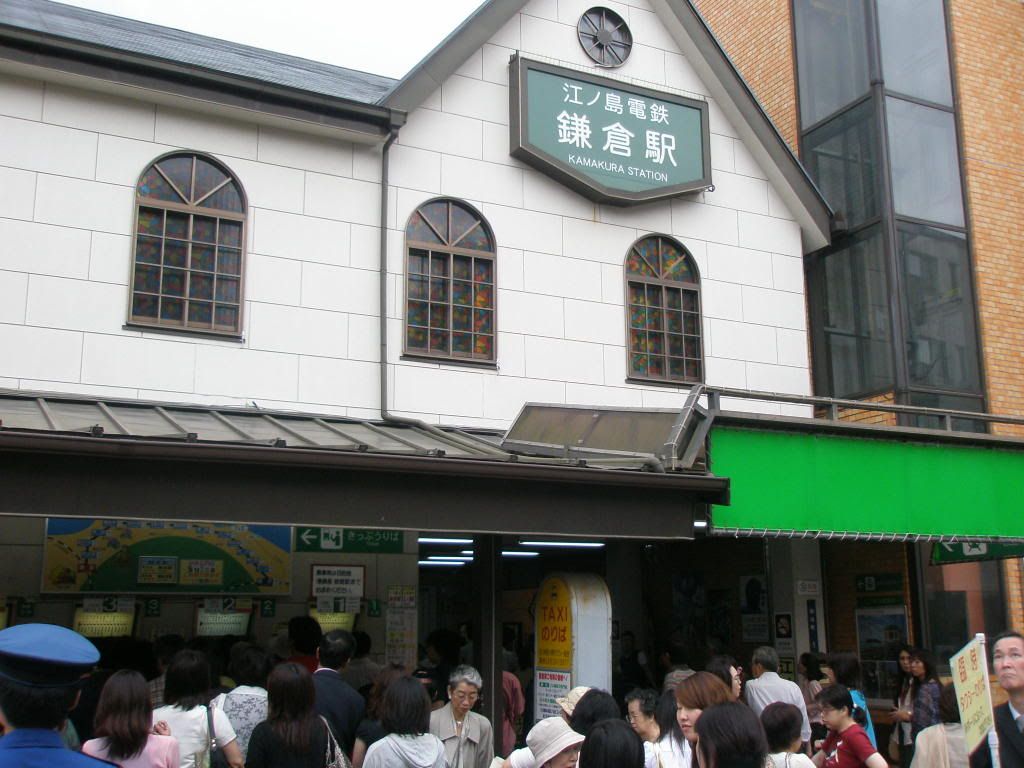
We fought our way out of the station and started to make our way through the city. My original plan was to do a few of the hiking trails in my book, which hit the Buddha first and then a few of the major temples and shrines before ending up at Kita-Kamakura station but that didn't happen. I side tracked us and took us to a few smaller shrines that I saw signs for and ended up doing the route of the course in reverse.
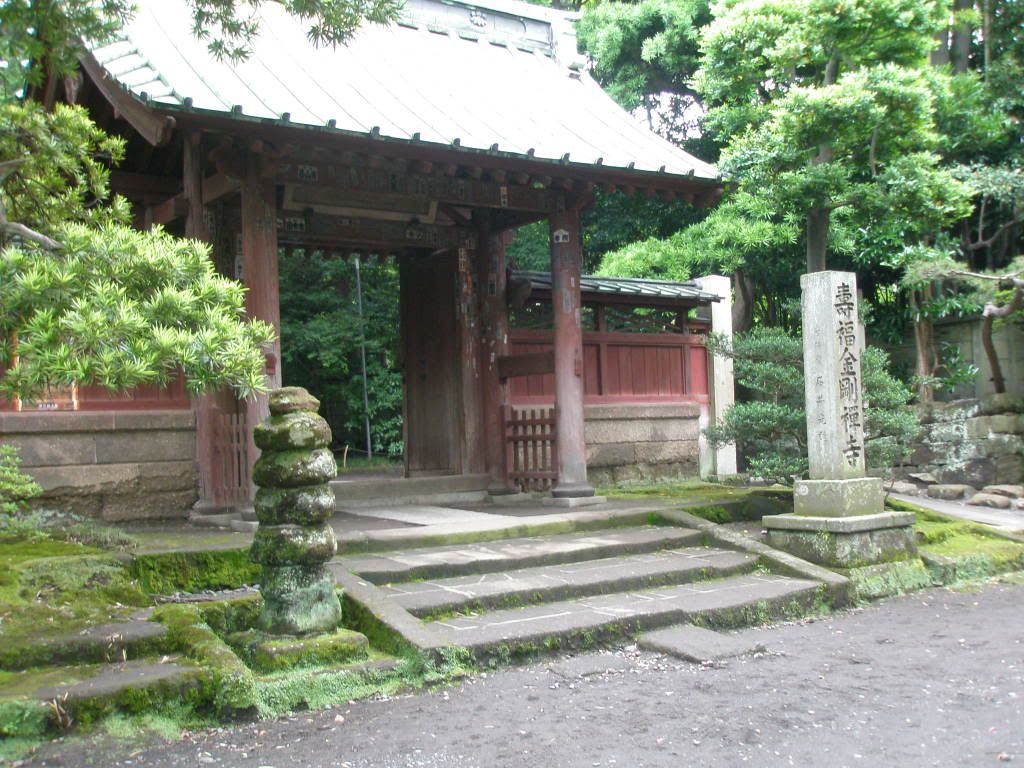
Our first major stop was 寿福寺 Jufuku-ji. This Rinzai sect temple is the oldest Zen temple in Kamakura, ranked third among Kamakura's Five Mountain temples. Here, they worship Shakymuni, the Buddha. This temple was founded by Hojo Masako (1157-1225) to enshrine her dead husband, the founder of the Kamakura shogunate, Minamoto Yoritomo (1147-1199). She installed Eisai as the founding priest, who was ordained in China and brought Zen buddhism to Japan. He is also credited with bringing green tea to Japan, which was orginally used to keep monks awake during long sessions of meditation. Look, I learned something in Asian Studies; I bet you didn't know that.
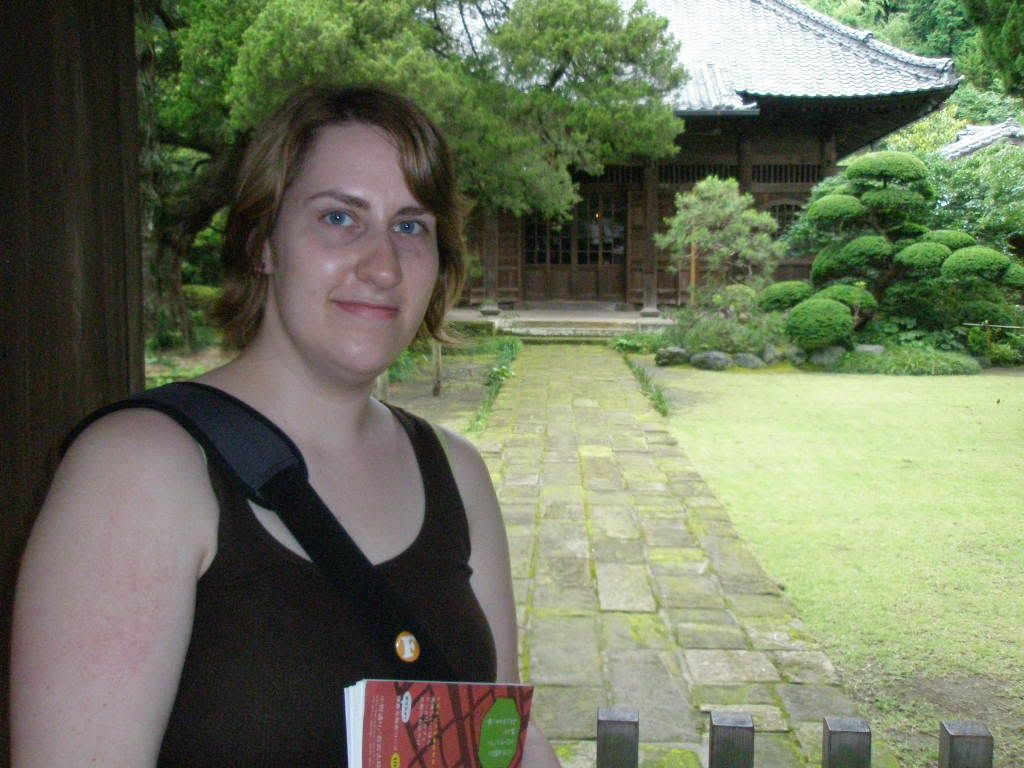
The main hall is closed to visitors, which is a shame. It was so peaceful and calm there... we could see monks walking around inside and a family coming out of the reception area. Apparently (as Wikipedia tells me) there are 3 statues of Shakyamuni, an eleven-headed goddess Kannon and two Deva Kings inside. Behind the hall is a graveyard as well, where all the head priests of the temple are buried. There are a few graves dedicated to some Minamotos, some foreigners and a few literary celebrities.
Next we made our way to 銭洗弁天 Zeniarai Benten, "Money-washing Benten". It was near by but you had to up this steep hill to get to the entrance. This is when we started to see some crowds, and a lot of foreigners. It was quite nice and cool up on the top of the hill though because there was a lot of shade from trees and nice cool caves.
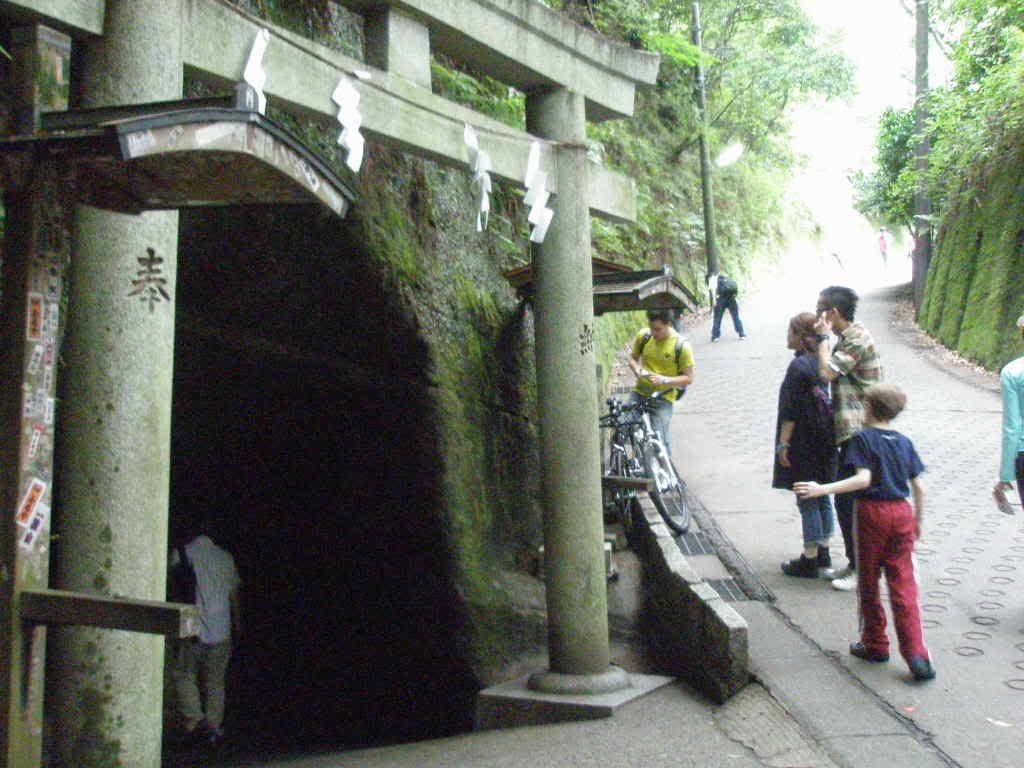
This is the second most popular spot in Kamakura, even though it's a good twenty minute hike from the station. Inside there were dozens of torii and the smell of incense. There were a bunch of buddha statues as well, which was interesting. Before the Meiji restoration, most shrines and temples had elements of both Buddhism and Shinto but due to this shrine's remote location (you can only reach it by this tunnel and it's surrounded by rock on all sides) they managed to keep their Buddhist icons. The two Deva Kings that are at Jufuku-ji were originally at the Hachiman temple before the restoration. The main deity of this shrine is

According to the sign at the entrance of the tunnel, the shrine was founded in 1185 when Minamoto Yoritomo on the day of the snake in the month of the snake dreamed of the God Ugafukujin. The god told him that "In a valley to the northwest, there is a miraculous spring that gushes out of the rocks. Go there and worship the gods of Shinto, and peace will come to your people." He found the spring and built a shrine for Ugafukijin. Later, the Shinto god was fused with Buddhist goddess Benzaiten, who is the incarnation of water. Ugafukujin is a god of harvest so people would come and wash their seeds in the spring in hopes of better harvests so the two gods came to be considered one and the same.

The water of the spring inside Zeniarai Benzaiten's cave is supposed to have the power to multiply the money it comes in contact with. This unique tradition of coming to wash your coins began in 1257 when Hojo Tokiyori came here and washed his coins with the spring's water, expressing the hope that they may be doubled. People heard the story, and the tradition was born. We found a huge pile of baskets inside the cave of the spring so we washed some money. I could always use more. LOL. There was signage in Japanese all over with random English on it that said, "Dries naturally". I wish I had taken a picture of it. I think they meant that you should let the money air dry instead of wiping it dry with a hankerchief to keep the luck of the spring water.

After dipping our money and exploring Zeniarai Benen we wandered around and found a sign pointing to another shrine, the next we were going to visit. It was a path at the back of the shrine, leading down some stairs instead of going back through and walking down the hill. We went that way instead, saving some time. It was also deserted so we didn't have to fight with the crowds. It went through the neighbourhood surrounding the temples so we could see all the nice expensive houses.

Our next stop was 佐助稲荷神社 Sasuke Inari Jinja, a shinto shrine at the top of a long set of stairs under a series of red torii and flanked by red flags. It was cool and dark at the top because of all the trees and serene and quite. The story goes that when Minamoto Yoritomo was in exile in Izu, he fell ill and an old man appeared to him in a dream. The man held some herbs in his hand and showed them to Yoritomo, saying, “Make these into medicine, take it, and you will be cured. When you recover, immediately take up arms against the Taira. Victory will be yours.” Yoritomo asked the man his name and he replied, “I am the god of the hidden hamlet in Kamakura,” then vanished. Yoritomo succeeded in establishing his government and believed the success was due to the advice of the old man. He later ordered his men to search for the abode of the god, and in Kamakura, west of the hidden hamlet they found a shrine. Yoritomo immediately replaced the old shrine with a newly-built one and named it Sasuke Inari. The sa (佐) in Sasuke was part of the name Yoritomo held in his youth, 佐殿
(but pronounced Sukedono). The suke in Sasuke means “to help.” The name “Sasuke” was used as the name of this shrine because “Sukedono was helped by a god.”

All over the shrine were these tiny fox figures that people left as an offering to the gods. Apparently there are five deities enshrined here, according to the sign I read. The main object of worship in an Inari shrine is a Shinto deity called Uka no Mitama, who is believed to be the patron deity of agriculture, grain in particular. Inari shrines are closely associated with the fox, which is believed to be the messenger of the Inari deity. A pair of fox statues are always sitting in front of all Inari shrines just like a pair of dogs at other Shinto shrines. Why it's a fox? I don't know. I thought they were cats at first, but after doing some research, learned they were foxes.
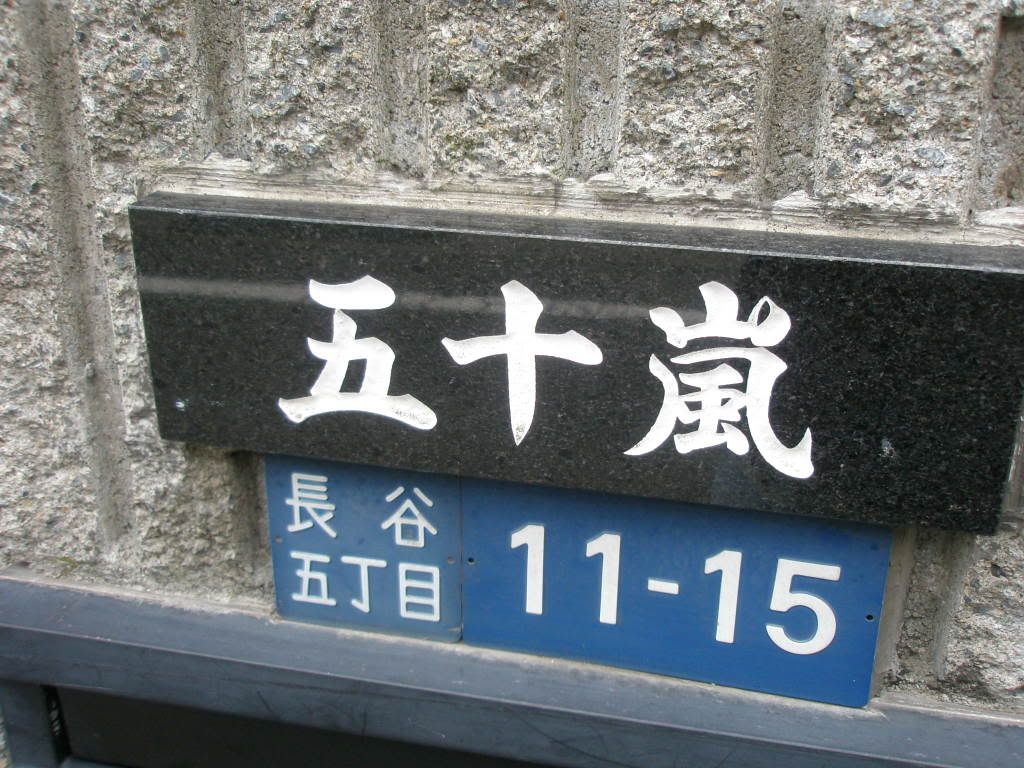
After finishing at Sasuke Inari, we headed back down and made for the main attraction, the big Buddha. As we walked through the streets and saw the swanky houses, I saw this name plate, and just had to take a picture:

When we got to the main road, there were hoards of people, heading to and from the Buddha. There were souvenir shops all over the place and it was just... gawdy. I doubt if Kotoku-in has any religious significance left amongst all the tourists.

In any case, I was impressed. Nikki says the one in Hong Kong is bigger, and the statue of Kuan-yin in Taiwan is probably bigger than this, but I was awed. The bronze statue of Amida Buddha stands at 13.35 metres tall, weighing 93 tons. It was said to be contructed in 1252 but there is no proof that this is the orginally statue. I made a prayer to Buddha with the rest of the people and got some postcards. For 200 yen, we were there for a max of 10 minutes. You can buy all sort of amulets and charms and for 20 yen you can go inside the Buddha but Justin said it's not that impressive so we didn't bother. We didn't really feel like sticking around because we were getting hungry.
Every place we looked into was either full or too expensive for our tastes (but not wholly unexpected in Kamakura) but we eventually made it to the Enoden train and took it back to Kamakura station and found a kaiten sushi restaurant and ate. I had wanted to have something more local but we were getting desperate. After eating we headed in the other direction of the station to see more stuff!

We made our way through the crowded shopping street to 鶴岡八幡宮 Tsuruguoka Hachiman-gu, the most important shrine in the city. When we go there, there was a wedding party taking photographs in front of the arched bridge. Everyone was taking pictures so I thought, why not? How often are we going to get to see a wedding party in full kimono? The arched bridge was supposedly for the shogun's use only; there are two other flat bridges for use by the common folk.

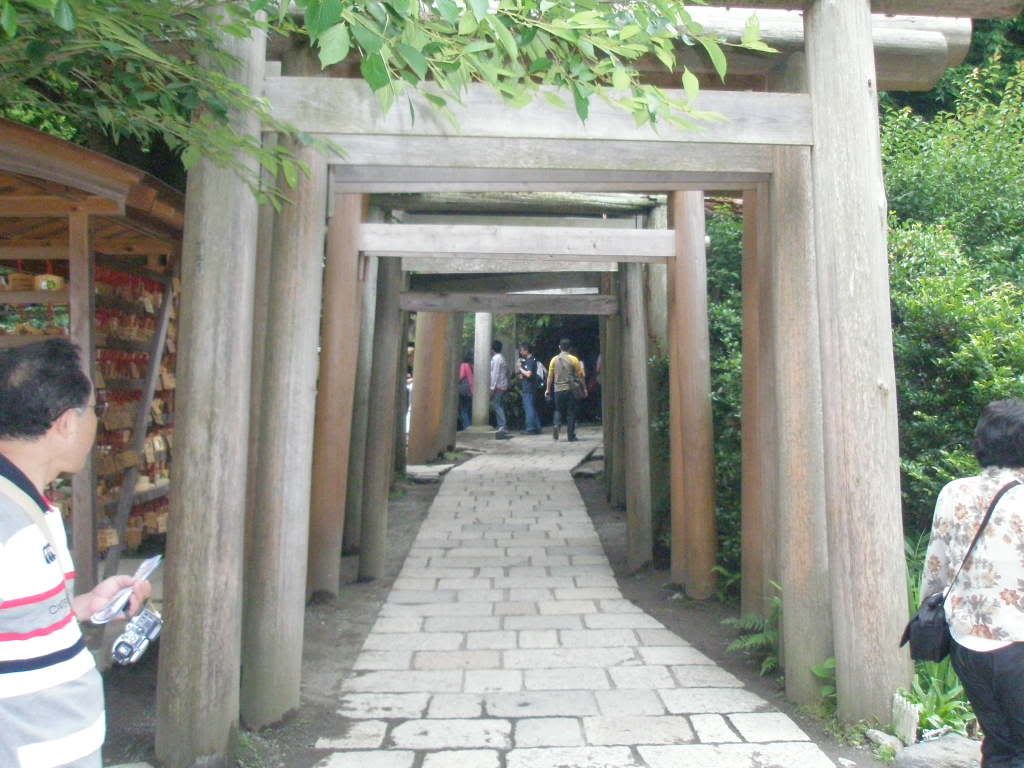
According to the sign at the entrance of the tunnel, the shrine was founded in 1185 when Minamoto Yoritomo on the day of the snake in the month of the snake dreamed of the God Ugafukujin. The god told him that "In a valley to the northwest, there is a miraculous spring that gushes out of the rocks. Go there and worship the gods of Shinto, and peace will come to your people." He found the spring and built a shrine for Ugafukijin. Later, the Shinto god was fused with Buddhist goddess Benzaiten, who is the incarnation of water. Ugafukujin is a god of harvest so people would come and wash their seeds in the spring in hopes of better harvests so the two gods came to be considered one and the same.
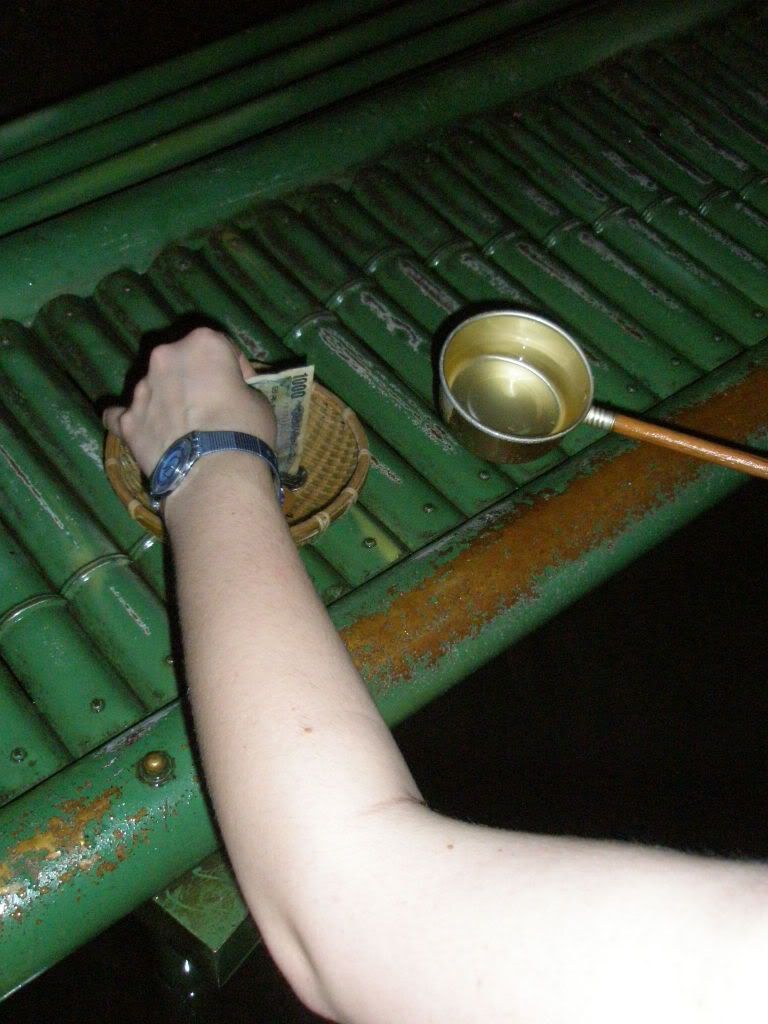
The water of the spring inside Zeniarai Benzaiten's cave is supposed to have the power to multiply the money it comes in contact with. This unique tradition of coming to wash your coins began in 1257 when Hojo Tokiyori came here and washed his coins with the spring's water, expressing the hope that they may be doubled. People heard the story, and the tradition was born. We found a huge pile of baskets inside the cave of the spring so we washed some money. I could always use more. LOL. There was signage in Japanese all over with random English on it that said, "Dries naturally". I wish I had taken a picture of it. I think they meant that you should let the money air dry instead of wiping it dry with a hankerchief to keep the luck of the spring water.

After dipping our money and exploring Zeniarai Benen we wandered around and found a sign pointing to another shrine, the next we were going to visit. It was a path at the back of the shrine, leading down some stairs instead of going back through and walking down the hill. We went that way instead, saving some time. It was also deserted so we didn't have to fight with the crowds. It went through the neighbourhood surrounding the temples so we could see all the nice expensive houses.
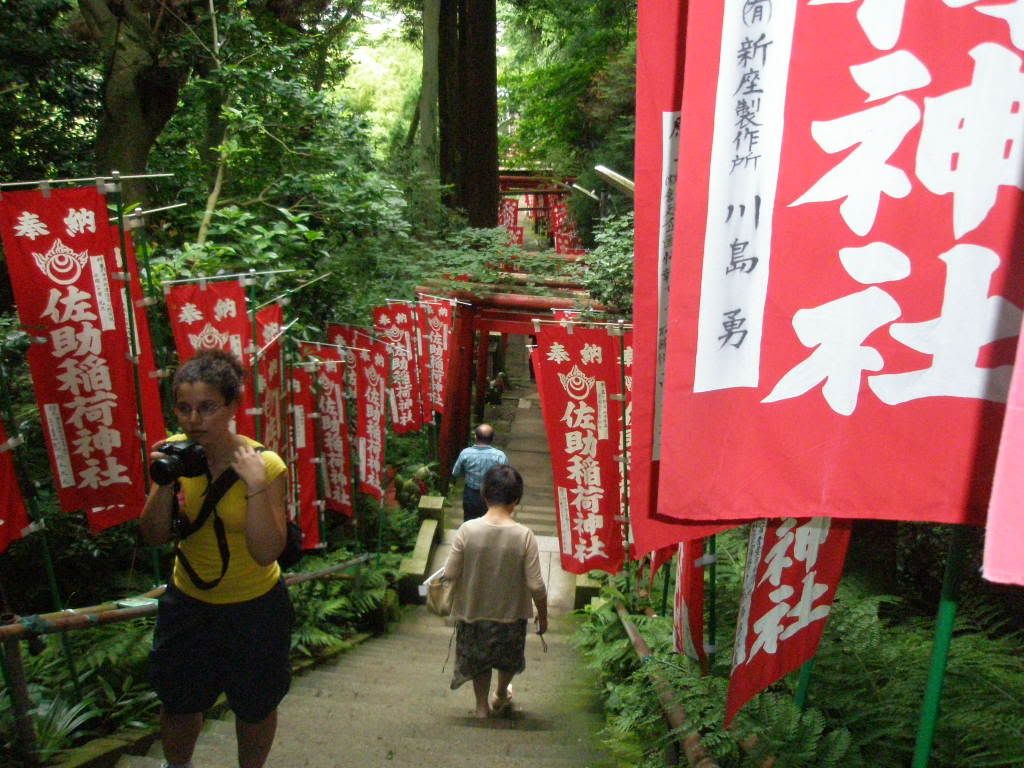
Our next stop was 佐助稲荷神社 Sasuke Inari Jinja, a shinto shrine at the top of a long set of stairs under a series of red torii and flanked by red flags. It was cool and dark at the top because of all the trees and serene and quite. The story goes that when Minamoto Yoritomo was in exile in Izu, he fell ill and an old man appeared to him in a dream. The man held some herbs in his hand and showed them to Yoritomo, saying, “Make these into medicine, take it, and you will be cured. When you recover, immediately take up arms against the Taira. Victory will be yours.” Yoritomo asked the man his name and he replied, “I am the god of the hidden hamlet in Kamakura,” then vanished. Yoritomo succeeded in establishing his government and believed the success was due to the advice of the old man. He later ordered his men to search for the abode of the god, and in Kamakura, west of the hidden hamlet they found a shrine. Yoritomo immediately replaced the old shrine with a newly-built one and named it Sasuke Inari. The sa (佐) in Sasuke was part of the name Yoritomo held in his youth, 佐殿
(but pronounced Sukedono). The suke in Sasuke means “to help.” The name “Sasuke” was used as the name of this shrine because “Sukedono was helped by a god.”
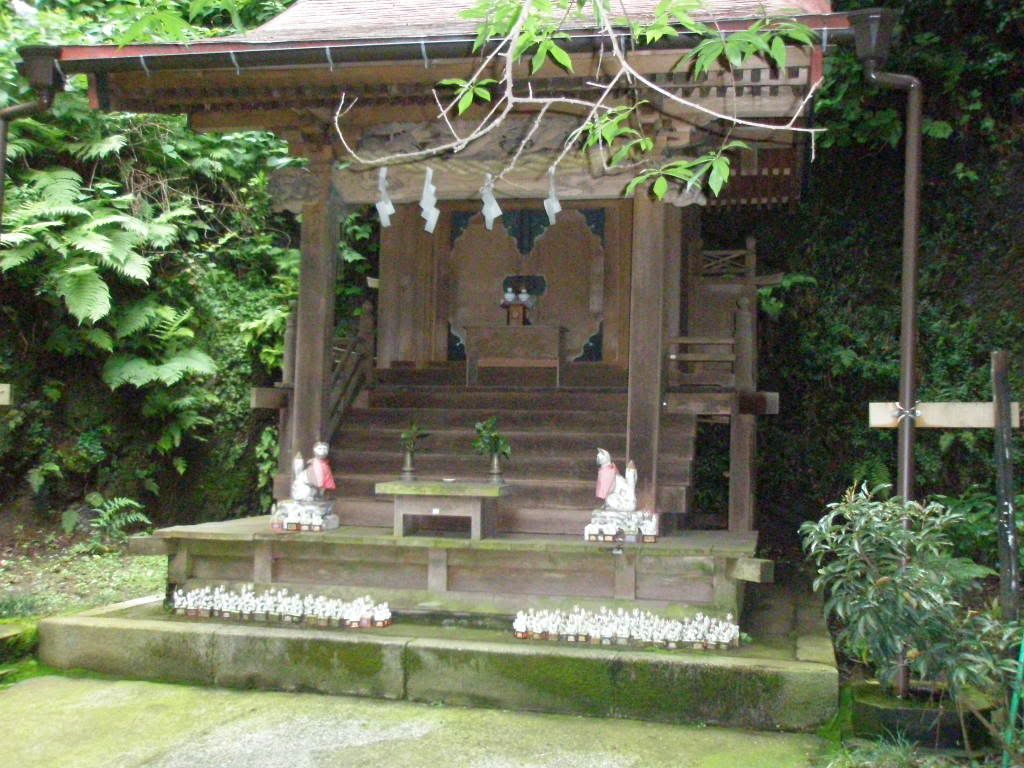
All over the shrine were these tiny fox figures that people left as an offering to the gods. Apparently there are five deities enshrined here, according to the sign I read. The main object of worship in an Inari shrine is a Shinto deity called Uka no Mitama, who is believed to be the patron deity of agriculture, grain in particular. Inari shrines are closely associated with the fox, which is believed to be the messenger of the Inari deity. A pair of fox statues are always sitting in front of all Inari shrines just like a pair of dogs at other Shinto shrines. Why it's a fox? I don't know. I thought they were cats at first, but after doing some research, learned they were foxes.
After finishing at Sasuke Inari, we headed back down and made for the main attraction, the big Buddha. As we walked through the streets and saw the swanky houses, I saw this name plate, and just had to take a picture:
When we got to the main road, there were hoards of people, heading to and from the Buddha. There were souvenir shops all over the place and it was just... gawdy. I doubt if Kotoku-in has any religious significance left amongst all the tourists.

In any case, I was impressed. Nikki says the one in Hong Kong is bigger, and the statue of Kuan-yin in Taiwan is probably bigger than this, but I was awed. The bronze statue of Amida Buddha stands at 13.35 metres tall, weighing 93 tons. It was said to be contructed in 1252 but there is no proof that this is the orginally statue. I made a prayer to Buddha with the rest of the people and got some postcards. For 200 yen, we were there for a max of 10 minutes. You can buy all sort of amulets and charms and for 20 yen you can go inside the Buddha but Justin said it's not that impressive so we didn't bother. We didn't really feel like sticking around because we were getting hungry.
Every place we looked into was either full or too expensive for our tastes (but not wholly unexpected in Kamakura) but we eventually made it to the Enoden train and took it back to Kamakura station and found a kaiten sushi restaurant and ate. I had wanted to have something more local but we were getting desperate. After eating we headed in the other direction of the station to see more stuff!
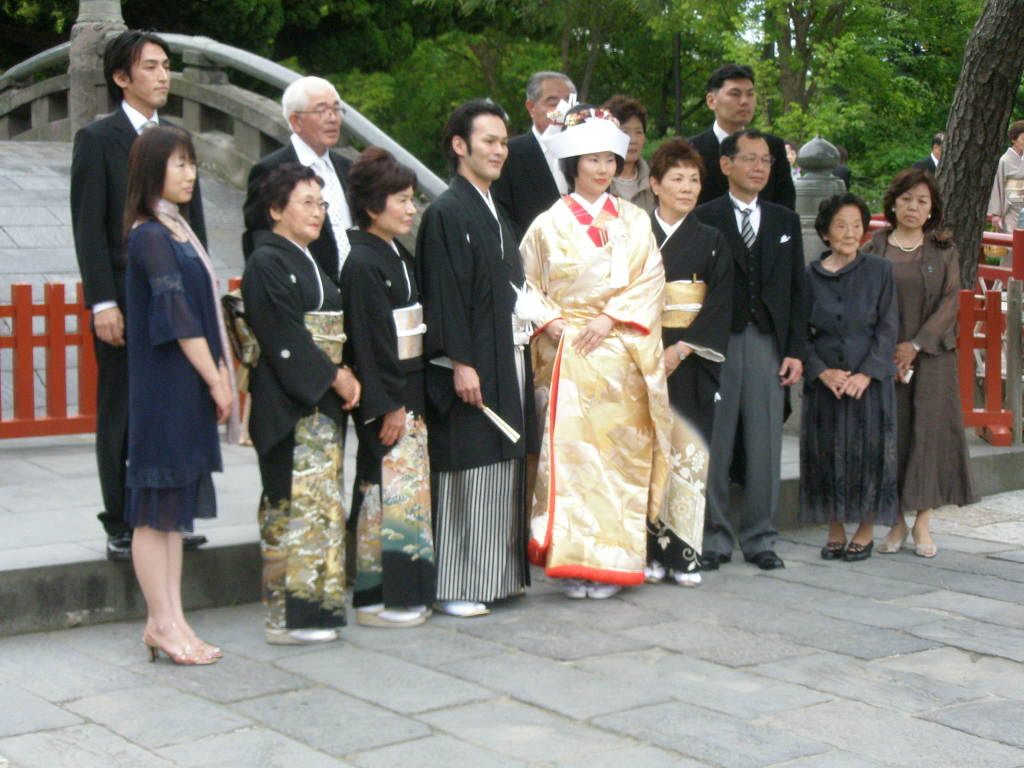
We made our way through the crowded shopping street to 鶴岡八幡宮 Tsuruguoka Hachiman-gu, the most important shrine in the city. When we go there, there was a wedding party taking photographs in front of the arched bridge. Everyone was taking pictures so I thought, why not? How often are we going to get to see a wedding party in full kimono? The arched bridge was supposedly for the shogun's use only; there are two other flat bridges for use by the common folk.
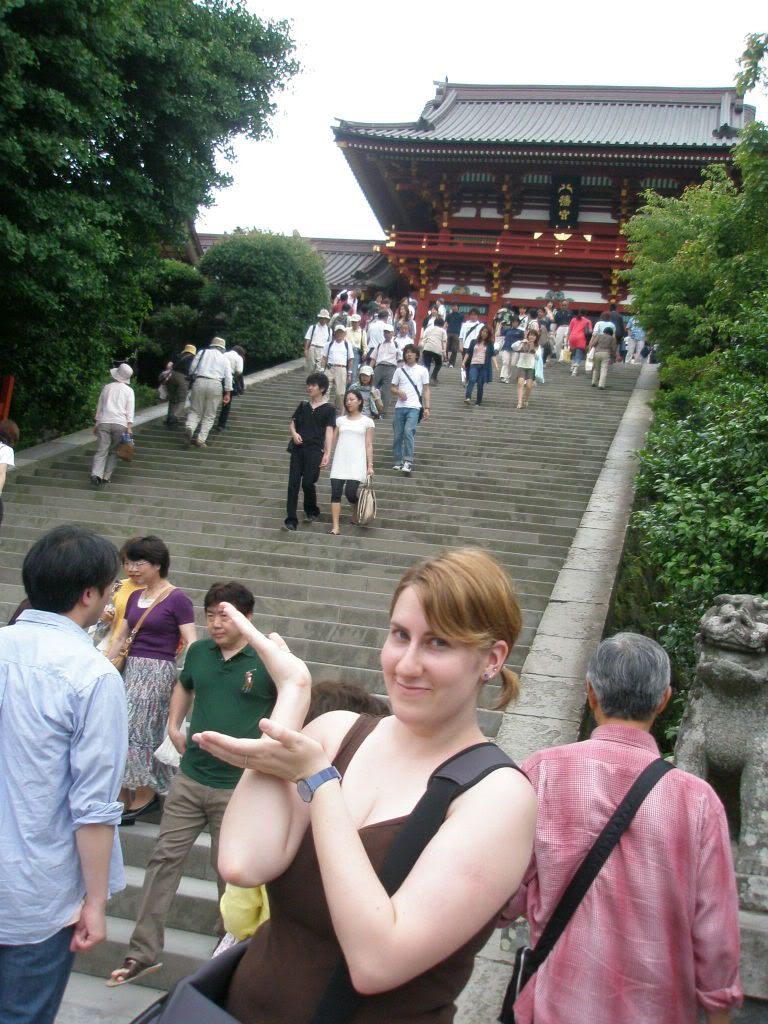
After walking up the long 1.8km boulevard and climbing a big set of stairs, we got to the shrine. This shrine, which used to be also a Buddhist temple and far bigger than today, was originally built in 1063 in Zaimokuza where the tiny Moto Hachiman shrine now stands, and was dedicated to the Emperor Ōjin, his mother Empress Jingu and his wife Hime-gami. Minamoto Yoritomo moved it to its present location in 1191 and invited Hachiman, the god worshiped popularly among warriors, to reside there and guard his government.

There was a pavillion after the first set of stairs, then another set leading up to the main temple structure. We could see priests roaming around in robes and hundreds of people. There were two moms (or grandmas) with new-born babies getting blessed. Justin took a picture, I'll post it later. At the top you could see a view of the city and the first torii at the edge of the grounds. I got a fortune from the temple, 吉 (kichi, good luck!) and took in the view. When we got down to the pavillion got to witness a shinto wedding ceremony! After taking a few vidoes, my battery died. :(
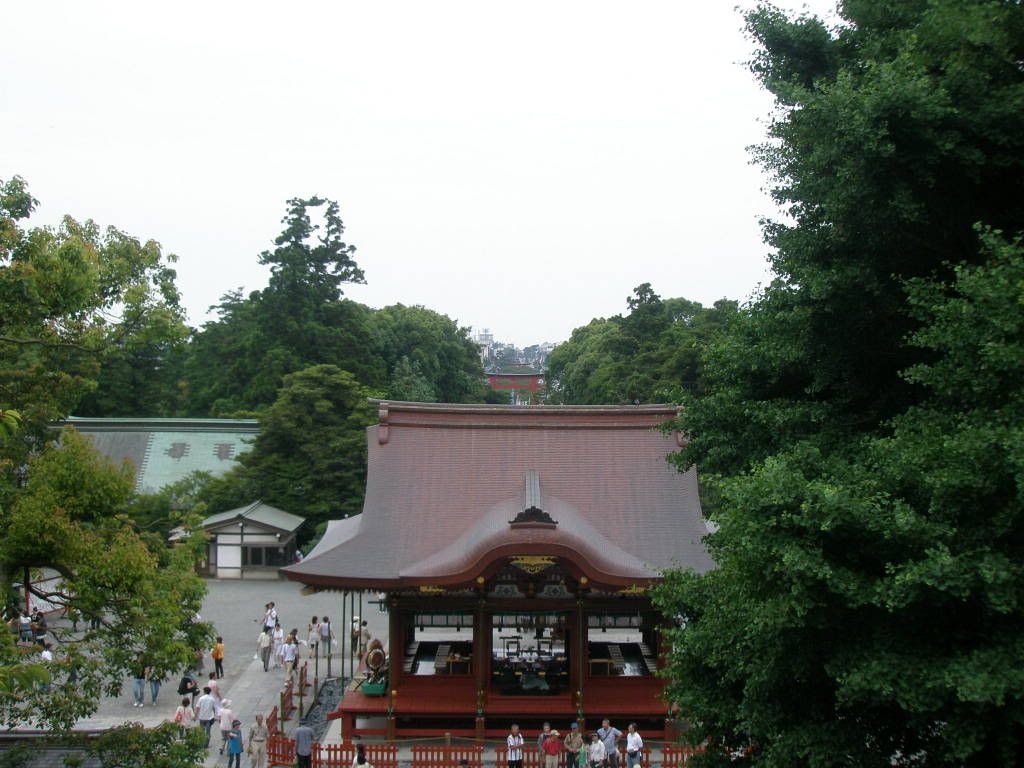
There was a pavillion after the first set of stairs, then another set leading up to the main temple structure. We could see priests roaming around in robes and hundreds of people. There were two moms (or grandmas) with new-born babies getting blessed. Justin took a picture, I'll post it later. At the top you could see a view of the city and the first torii at the edge of the grounds. I got a fortune from the temple, 吉 (kichi, good luck!) and took in the view. When we got down to the pavillion got to witness a shinto wedding ceremony! After taking a few vidoes, my battery died. :(
After that, we left and hit a few more shrines: 鎌倉宮 Kamakura-gu, 宝戒寺 Hokai-ji, and 源頼朝の墓 Minamoto Yoritomo no Bo, the grave of Minamoto Yoritomo.
Kamakura-gu is a shinto shrine and I thought would be pretty major because it is named after the city, but it was pretty minor. The Shrine is considerably new, erected to the spirit of Prince Morinaga (1308-1335), child of Emperor Godaigo (1288-1339). It was back in 1333, the year the Kamakura Shogunate terminated and the ruling power was temporarily handed over to Emperor Godaigo. The Imperial Court finally restored the sovereignty as a ruler of Japan. However, his regime did not long last. Takauji Ashikaga (1305-1358), the founder of the Ashikaga Shogunate, first sided with the Emperor and helped him to win the battle against the Hojos in Kamakura. However, he changed sides suddenly and tried to establish his own government betraying the Emperor. Across the street, up the hill on the east of the Shrine is the graveyard for the Prince. This grave is now under the care of the Imperial Household Agency, and the tomb faces south as is the case of Imperial tombs. Prince Morinaga cannot be entombed inside the Shrine precinct under the Japanese Constitution, which guarantees the freedom of religion and prohibits the government from giving any aids to a specific institution, be it Shinto, Buddhism or Christianity, and therefore, the Imperial Household Agency, a government body, placed his grave separately from the Shrine.
This shrine performs Noh plays in October and there are also some clay bowls you can break to ward off evil, and lion head charms to buy. We took a rest at the rest house adjacent with some ice cream and continued onto Houkai-ji. This is a Tendai Buddhist temple constructed in 1335 by the order of Emporer Godaigo. The site was where the Komachi residence of the Hojos, for nine generations, had been located until the family, regents to the Kamakura shogunate, fell in 1333. The emperor ordered the construction of the temple for the repose of the deceased Hojos. In 1538, the temple burned down and a priest of another temple requested shogun Tokugawa Ieyasu at the beginning of the Edo period to officially support Houkai-ji as it was an important temple of the Tendai school. According to the print out I got (and just copied all that infromation from), it continues to play an important role of being a place for learning Buddhist teachings.
This was the first temple we could actually go into, so I went in and took a look around. There were some charms for sale, of course, and alters of buddhas and offerings. There was a guest book as well, so I wrote a short message. The monk gave me a weird look as he stowed away the vacuum cleaner sitting in the middle of the room.
Our last stop, only because we passed by and it wasn't listed as a temple or shrine on the sign post, as the grave of Minamoto Yoritomo. Only after having written this out, do I realize what an influential person he was. I doubt that he is actually buried there, but it was cool to see anyway.
And that was my day. It was so cool to see all these places that had so much influence and have remained in history for so long... I studied Japanese buddhism in school and seeing these places that were founded by people I read about first hand, was just amazing. :) I definitely want to make another trip (maybe when it isn't a weekend) and see some of the places I missed and maybe even go to a meditation session at one of the temples.
Kamakura-gu is a shinto shrine and I thought would be pretty major because it is named after the city, but it was pretty minor. The Shrine is considerably new, erected to the spirit of Prince Morinaga (1308-1335), child of Emperor Godaigo (1288-1339). It was back in 1333, the year the Kamakura Shogunate terminated and the ruling power was temporarily handed over to Emperor Godaigo. The Imperial Court finally restored the sovereignty as a ruler of Japan. However, his regime did not long last. Takauji Ashikaga (1305-1358), the founder of the Ashikaga Shogunate, first sided with the Emperor and helped him to win the battle against the Hojos in Kamakura. However, he changed sides suddenly and tried to establish his own government betraying the Emperor. Across the street, up the hill on the east of the Shrine is the graveyard for the Prince. This grave is now under the care of the Imperial Household Agency, and the tomb faces south as is the case of Imperial tombs. Prince Morinaga cannot be entombed inside the Shrine precinct under the Japanese Constitution, which guarantees the freedom of religion and prohibits the government from giving any aids to a specific institution, be it Shinto, Buddhism or Christianity, and therefore, the Imperial Household Agency, a government body, placed his grave separately from the Shrine.
This shrine performs Noh plays in October and there are also some clay bowls you can break to ward off evil, and lion head charms to buy. We took a rest at the rest house adjacent with some ice cream and continued onto Houkai-ji. This is a Tendai Buddhist temple constructed in 1335 by the order of Emporer Godaigo. The site was where the Komachi residence of the Hojos, for nine generations, had been located until the family, regents to the Kamakura shogunate, fell in 1333. The emperor ordered the construction of the temple for the repose of the deceased Hojos. In 1538, the temple burned down and a priest of another temple requested shogun Tokugawa Ieyasu at the beginning of the Edo period to officially support Houkai-ji as it was an important temple of the Tendai school. According to the print out I got (and just copied all that infromation from), it continues to play an important role of being a place for learning Buddhist teachings.
This was the first temple we could actually go into, so I went in and took a look around. There were some charms for sale, of course, and alters of buddhas and offerings. There was a guest book as well, so I wrote a short message. The monk gave me a weird look as he stowed away the vacuum cleaner sitting in the middle of the room.
Our last stop, only because we passed by and it wasn't listed as a temple or shrine on the sign post, as the grave of Minamoto Yoritomo. Only after having written this out, do I realize what an influential person he was. I doubt that he is actually buried there, but it was cool to see anyway.
And that was my day. It was so cool to see all these places that had so much influence and have remained in history for so long... I studied Japanese buddhism in school and seeing these places that were founded by people I read about first hand, was just amazing. :) I definitely want to make another trip (maybe when it isn't a weekend) and see some of the places I missed and maybe even go to a meditation session at one of the temples.